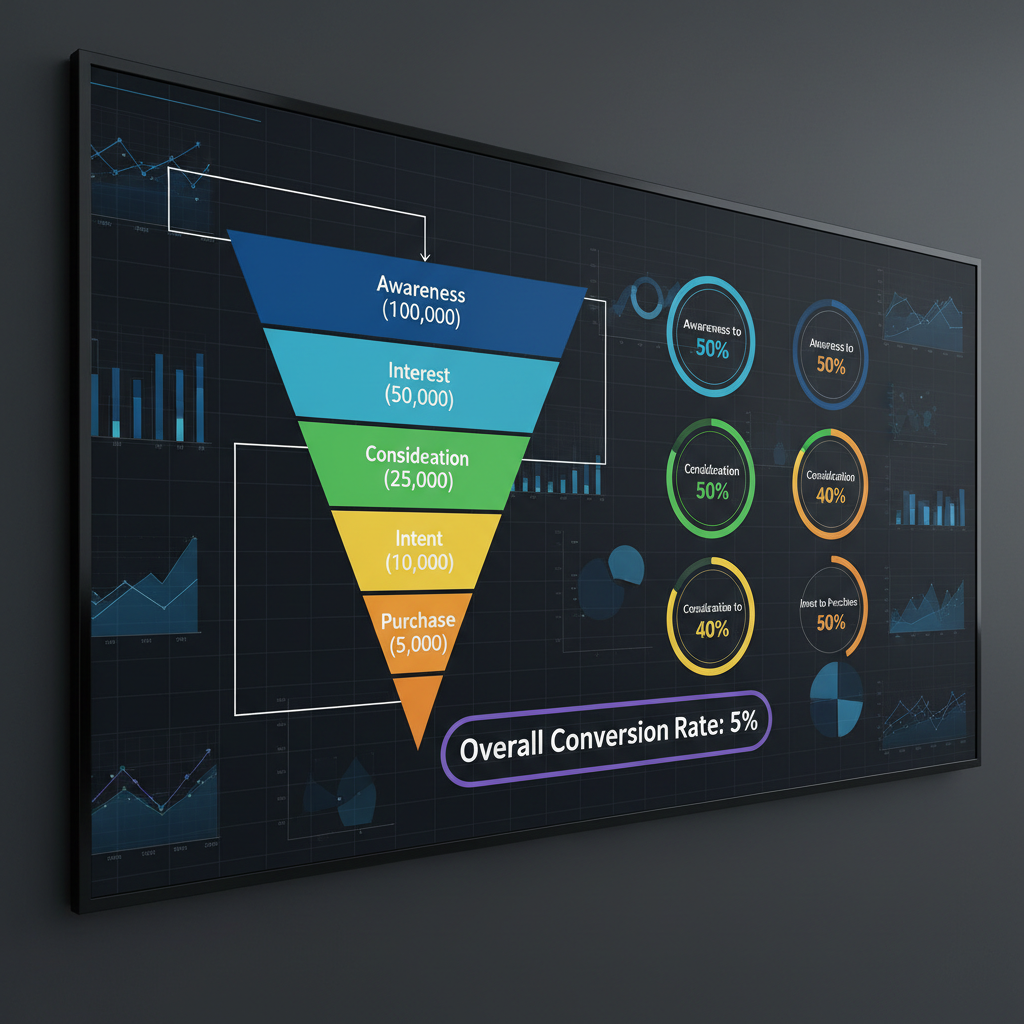
A funnel is not a landing page. It is not a sequence of emails. It is not a checkout flow. A funnel is the complete, engineered journey from a stranger's first encounter with your brand to the moment they become a loyal, high-value customer. The campaigns that generate $10M+ in revenue are built on a precise understanding of this journey — and every element within it.
The Four Stages of a High-Converting Funnel
Every effective funnel — regardless of industry, price point, or product type — moves prospects through four distinct psychological stages. Understanding these stages is the foundation of everything else.
- Awareness: The prospect encounters your brand for the first time. Your job is to interrupt their scroll and create enough curiosity to earn the next click.
- Consideration: The prospect is evaluating whether your solution is right for them. Your job is to build trust, demonstrate expertise, and address objections.
- Decision: The prospect is ready to buy but needs a reason to act now. Your job is to create urgency, reduce risk, and make the purchase feel inevitable.
- Retention: The customer has bought. Your job is to deliver on your promise, create a remarkable experience, and engineer the conditions for repeat purchase and referral.
The Landing Page Architecture That Converts
The highest-converting landing pages we have built share a consistent structural pattern. This is not a template — it is a psychological sequence that mirrors how buyers actually make decisions.
The 7-Block Landing Page Structure
- Block 1 — Hero: Outcome-focused headline + specific sub-headline + single CTA
- Block 2 — Problem Agitation: Name the pain precisely. Make the reader feel understood.
- Block 3 — Solution Introduction: Position your offer as the logical answer to the problem
- Block 4 — Social Proof: Specific testimonials with names, photos, and measurable results
- Block 5 — Offer Stack: Break down everything included. Make the value feel overwhelming.
- Block 6 — Objection Handling: Address the top 3–5 reasons people do not buy
- Block 7 — Final CTA: Restate the transformation. Create urgency. Remove risk.
“The best landing page copy reads like a conversation with someone who already knows your prospect's deepest frustrations and most desired outcomes. That level of specificity only comes from research.”
Email Automation: The Revenue Engine
For most of our clients, email automation generates 30–40% of total revenue. The key is building sequences that feel personal and relevant, not broadcast and generic. Every automation we build is triggered by behaviour — what the subscriber clicked, what page they visited, what they bought or did not buy.
The most valuable automation sequence is the abandoned cart or abandoned checkout flow. A well-built 3-email sequence (sent at 1 hour, 24 hours, and 72 hours) typically recovers 15–25% of abandoned revenue.
Core Automation Sequences
- Welcome sequence (5–7 emails): Deliver the lead magnet, establish authority, introduce your offer
- Nurture sequence (ongoing): Weekly value emails that build relationship and prime for purchase
- Abandoned cart (3 emails): Reminder, social proof, final urgency with risk reversal
- Post-purchase (3–5 emails): Onboarding, usage tips, upsell introduction, review request
- Win-back (3 emails): Re-engage inactive subscribers before removing them from your list
The Upsell Architecture
The most profitable funnels are not built on the front-end offer. They are built on what happens after the first purchase. An order bump (offered on the checkout page) and a one-click upsell (offered immediately after purchase) can increase average order value by 40–80% without acquiring a single additional customer.
The rule for upsells is simple: the offer must be a logical, immediate complement to what the customer just bought. It should feel like the obvious next step, not a separate sale. When positioned correctly, a well-crafted upsell feels like a favour, not a pitch.
Measurement: The Metrics That Actually Matter
- Opt-in rate: Benchmark 30–50% for cold traffic landing pages
- Sales conversion rate: Benchmark 1–3% for cold traffic, 5–15% for warm/email traffic
- Average order value (AOV): Track this weekly — it is the fastest lever to increase revenue
- Customer lifetime value (LTV): The metric that determines how much you can afford to spend on acquisition
- Email open rate and click rate: Indicators of list health and content relevance
The $10M campaigns are not built on luck or a single viral moment. They are built on systems — tested, measured, and optimised over time. Every element of the funnel is a variable. Every variable is an opportunity to improve. The businesses that win are the ones that never stop testing.